6 hr
San Sebastián Coffee Farm Experience with Traditional Lunch
Immersive half-day journey to a working coffee plantation near Medellín with hands-on harvesting and tasting
Reserve
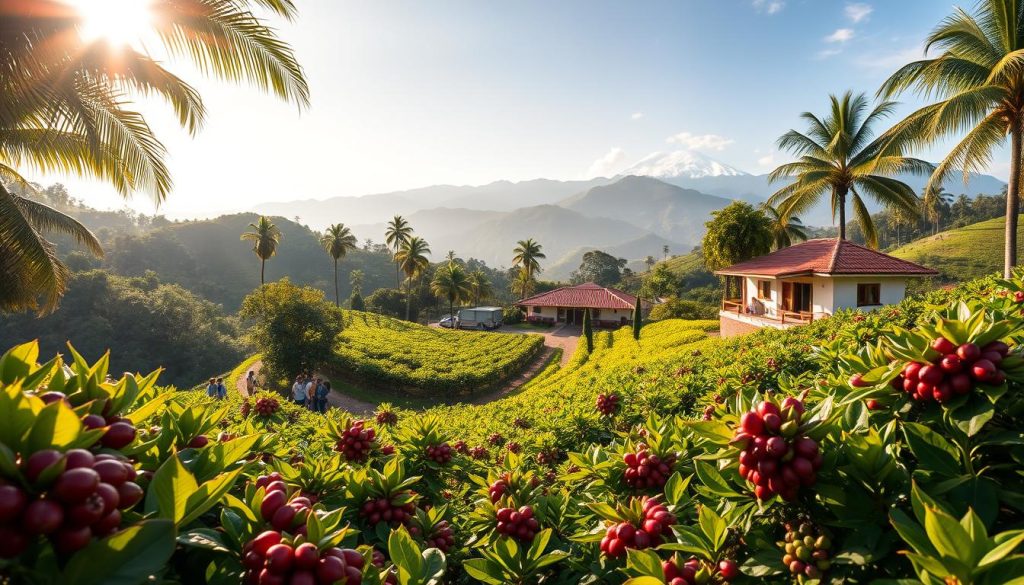
Green slopes wake before the city, cherries redden in the mist.
Hand-picked by our editors — only the best 5 experiences from 60 reviewed.
Verified partners for every tour, free cancellation where available, and instant confirmation on every booking.
6 hr
Immersive half-day journey to a working coffee plantation near Medellín with hands-on harvesting and tasting
Reserve
4 hr 30 min
Ride cable cars to a hillside coffee farm, harvest beans with a local family, and taste fresh brews
Reserve
4 hr
Journey into Colombia's coffee culture with hands-on harvesting, roasting, and a farm-to-table meal
ReservePrices from verified partners. Availability updates in real time at checkout. Free cancellation policies apply where shown.
The landmarks, rooms, and views travelers on this tour remember — all visible on a single visit.
Outdoor space on traditional steps for learning about coffee history and cultivation techniques. 577 steps provide a challenging but rewarding climb to these panoramic lecture points.
Features mechanical and artisanal equipment for depulping and roasting fresh coffee cherries. Witnessing the transformation from bean to cup is a central part of this facility.
Navigate the dense canopy where coffee plants thrive in the Antioquian climate. Farmers demonstrate proper cherry harvesting here during the active season.
A dedicated area for cupping different roasts and learning the sensory profiles of specialty Colombian coffee. This is where you learn to identify nuances in flavor, aroma, and acidity.
They complement each other; visitors seeking deep agricultural insight choose the medellin coffee farm tour for its immersion, while others prefer city-based sessions for accessibility. These medellin coffee farm tour tours provide access to high-altitude landscapes, whereas urban settings focus on sensory analysis.
| Feature | Top pick Antioquia Farm Excursion | Urban Coffee Tasting |
|---|---|---|
Setting |
Rural plantation | City center facility |
Depth of Process |
Harvesting and processing focus | Brewing and sensory analysis |
Travel Time |
60–90 minutes | 15–30 minutes |
Physical Demand |
577 steps required | None |
Authenticity Factor |
High (farm life) | Medium (educational focus) |
Accessibility |
Remote mountain access | Public transport hubs |
| See tickets → |
Verdict: Securing medellin coffee farm tour tickets is ideal for those who value seeing the full life cycle of the bean, while urban tasting sessions suit travelers prioritizing convenience.
Choose your ticket, select your date, and reserve in under two minutes. Secure checkout handled by our verified partner.
Instant confirmation by email, with a mobile voucher you can save offline. No printing, no queuing at a collection desk.
Arrive at the entrance, show your voucher on your phone, and walk in. Most tickets include priority or skip-the-line access.
Best time to go, insider tips, nearby landmarks, and the cancellation fine print — flip through to skim what matters to you.
How crowds, weather, and events shift across the year.
Drier weather makes walking the 577 steps easier and keeps mountain trails accessible.
Small details that turn a good visit into a great one.
Secure your medellin coffee farm tour at least 48 hours early to guarantee transport.
Non-bookable sights within a short walk — free to visit, easy to pair.
A replica of a traditional Antioquian village offering views of Medellín.
Flexible, no hidden fees.
Full refunds are typically provided for cancellations made at least 24 hours prior to the scheduled tour. Access requires a pre-booked commercial package as there is 0 COP standalone entrance fee.
Hand-picked options within walking distance — pick a district for vibe, or a specific hotel for convenience.
Main hotel district with the highest density of tour departure points.
Coffee reached Antioquia as a penance. Parish priests in the nineteenth century assigned seedlings to parishioners in confession, and the department that had lived on gold and cattle turned, tree by tree, into a coffee economy. The slopes above Medellín sit in the narrow altitude band the crop rewards most, roughly 1,300 to 2,000 metres, where cool nights slow the cherry's maturation and concentrate sugars. Antioquia's harvest runs twice a year — a principal cosecha in the last months of the year and a smaller mitaca around April and May — which is why the farms operate seven days a week, 08:00–17:00, rather than closing between seasons. Most of the region's producers are smallholders working under five hectares, and Colombia's Federación Nacional de Cafeteros, founded in 1927, still buys at a published daily price that reaches even the smallest finca. A medellin coffee farm tour is, in practice, a visit to that structure: a family holding, a wet mill, a drying patio. Two distinct geographies carry these visits today. San Sebastián de Palmitas is a corregimiento on Medellín's western edge, a rural district of switchback roads and cloud forest that remained connected to the city by a single old highway until the Túnel de Occidente opened in 2006. Barrio La Sierra, by contrast, sits inside the urban fabric on the city's eastern hillside, where coffee grows on terraced ground between houses — an unusual case of agriculture surviving inside a metropolis of 2.5 million. The processing sequence is the same in both places and largely unchanged since the 1930s. Ripe cherries are hand-picked selectively, since a single branch carries fruit at four stages of ripeness. They pass through a despulpadora, ferment in tiled tanks for twelve to eighteen hours, are washed, then dried on marquesinas — raised beds under translucent roofing — until moisture falls near eleven percent. Roasting and cupping follow, often at a table set with the same protocol Colombian graders use. The farmhouses themselves belong to the paisa vernacular: whitewashed adobe, tapia walls, corridors of turned wooden columns, bright painted doors and eaves. The terrain is steep, and access involves roughly 577 steps across paths and terraces. What visitors on a medellin coffee farm tour encounter is less a museum than a working landscape, one that shaped the architecture, the dialect and the wealth of Antioquia long before it shaped its tourism.

"Coffee reached Antioquia as a penance, assigned seedling by seedling in the confessional."
Bring sunscreen, insect repellent, a camera, and comfortable closed-toe walking shoes.
Photography is encouraged throughout the farm, including during the processing and roasting stages.
Most tour packages include a traditional Colombian paisa lunch as part of the full-day experience.
Cancellations made at least 24 hours in advance typically receive a full refund.